China, a country once known for its bustling bicycles and traditional combustion engine cars, has now firmly established itself as the world’s electric vehicle (EV) powerhouse. Almost half of all cars sold in China last year were electric, a striking contrast to the situation in many other parts of the world where EVs are still largely regarded as luxury items. China’s rise to the top in the EV market isn’t a mere coincidence—it is the result of a well-crafted, long-term strategy designed to put the country ahead in one of the most important technological races of the 21st century.
This shift has transformed the driving habits of millions. For people like Lu Yunfeng, a private hire driver from Guangzhou, driving an electric vehicle isn’t just about being environmentally conscious; it’s a financially practical choice. “I drive an electric vehicle because it saves me money,” says Lu, parked at a charging station on the outskirts of the city. His sentiments are echoed by many others who have embraced EVs not as a luxury, but as an affordable alternative to traditional petrol cars.
The Strategic Vision Behind China’s EV Dominance
At the turn of the century, China’s leadership made a decisive move to dominate key technologies that would shape the future. Among these was electric vehicle technology. At the time, China was still heavily reliant on bicycles, and the streets were dominated by foreign-made petrol and diesel cars. In cities like Beijing and Shanghai, domestic Chinese brands were virtually nonexistent, overshadowed by well-established European, American, and Japanese car manufacturers.
However, in the face of this challenge, Chinese authorities saw an opportunity. They recognized that the country had the necessary resources, a highly skilled workforce, and a robust manufacturing ecosystem to leapfrog over its foreign competitors by investing heavily in the electric car market. The result of this strategic pivot is a national EV market that is now the largest and fastest-growing in the world.
From Policy to Production: How the Chinese Government Enabled the EV Boom
The vision for China’s electric future took shape with the work of Wan Gang, a German-trained engineer and China’s minister of science and technology in the late 2000s. In 2007, Wan recognized that while China had become the largest car market globally, it was still heavily reliant on foreign carmakers. This reality led to the government’s long-term strategy to develop a strong domestic EV industry.
The Chinese government’s commitment to this cause was solidified in its five-year economic plan as early as 2001. However, it wasn’t until the 2010s that the government began to offer substantial subsidies to both consumers and manufacturers. This funding spurred innovation and investment, setting China on a path to becoming the world’s leader in electric vehicle production.
Between 2009 and 2023, China invested an estimated $231 billion in the electric vehicle sector, focusing on everything from carmakers and battery suppliers to infrastructure development. This large-scale financial commitment has been instrumental in developing a full EV ecosystem that spans everything from manufacturing and battery production to charging infrastructure.
The Rise of Domestic EV Giants
Thanks to these massive subsidies and supportive policies, China has produced a range of domestic carmakers that are not only competitive but have begun to dominate the global EV market. BYD, one of China’s largest and most successful electric vehicle manufacturers, surpassed Tesla to become the world’s top seller of electric cars in early 2025.
BYD’s rise is emblematic of the shift in China’s automotive industry. With a domestic market of over 1.4 billion people, the company has been able to leverage massive economies of scale, while also benefiting from the government’s push for more affordable, environmentally-friendly vehicles. In addition to BYD, a range of other Chinese start-ups, including XPeng, Nio, and Li Auto, are challenging both local and international carmakers by providing consumers with affordable yet high-tech electric vehicles.
A Deep Dive Into EV Supply Chains and Infrastructure
China’s EV dominance is not only a product of strong domestic car manufacturers but also the country’s strategic control over critical components like batteries. Companies such as CATL (Contemporary Amperex Technology Co. Limited), which began in 2011, now supply about a third of the batteries used in electric vehicles worldwide. These batteries are essential to powering the next generation of EVs, and China has emerged as a key player in this supply chain.
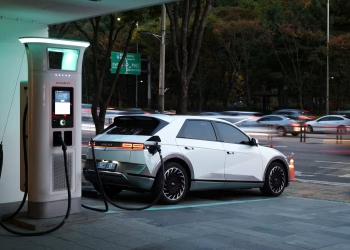
In addition to batteries, China has built the world’s largest public charging network, particularly concentrated in large cities like Beijing, Shanghai, and Guangzhou. This network has dramatically reduced the inconvenience associated with EVs and eliminated one of the major barriers to EV adoption in other parts of the world—charging infrastructure. With these stations scattered across urban centers, EV drivers rarely find themselves more than a few minutes away from a charging point, making electric cars a viable option for everyday use.
The Economic and Environmental Impact of China’s EV Push
The subsidies and support given to consumers to buy electric vehicles have drastically lowered the cost of ownership. People like Lu Yunfeng, who switched to an electric vehicle, now pay far less to maintain their cars. While filling up a petrol vehicle would have cost him 200 yuan ($27.84), he now spends only a quarter of that amount to charge his electric vehicle. This price advantage is one of the key drivers behind the growing number of Chinese consumers switching to EVs.
In addition to the cost savings, the environmental impact of China’s EV revolution cannot be overstated. The transition to electric vehicles has been a major factor in the country’s efforts to reduce its carbon footprint and improve air quality in congested urban areas. By pushing for electric cars, China is not just providing a solution to its energy needs but also positioning itself as a leader in the global effort to combat climate change.
The Road Ahead: Can Other Countries Keep Up?
While China has become the undisputed leader in electric vehicles, questions remain about whether other countries can catch up. The U.S., Europe, and Japan have been slow to build the kind of comprehensive, government-backed EV ecosystem that has been so successful in China. Moreover, with Chinese EV makers like BYD and XPeng now setting their sights on global expansion, traditional carmakers in Europe and North America face an uphill battle.
For example, the U.S. and Europe have imposed hefty import taxes on Chinese electric vehicles, hoping to protect their domestic car industries. However, the UK has not followed suit, and companies like XPeng are now entering the British market with models priced as low as $26,100. This makes China’s electric vehicles an attractive option for consumers in markets that are looking to transition to cleaner, more affordable transportation options.
The Competitive Edge: Innovation, Affordability, and Government Support
What sets China apart from the rest of the world when it comes to electric vehicles is the combination of government support, innovation, and fierce competition. The government’s long-term planning, massive investment, and policies designed to promote electric vehicles have allowed the country to leap ahead of others in both technology and affordability.
Meanwhile, Chinese startups like XPeng and Nio have made a habit of offering cutting-edge features at a fraction of the cost of their foreign competitors. Features like self-driving capabilities, advanced voice activation systems, and ultra-fast battery swapping technology have become standard in Chinese-made EVs, making them not only affordable but technologically advanced.
While the global market for EVs is expanding, China’s dominance in this sector is unlikely to be challenged anytime soon. With more affordable options, a vast domestic market, and continuous innovation, China’s electric vehicle industry is not only leading the world today but is also well-positioned to drive global change for years to come.