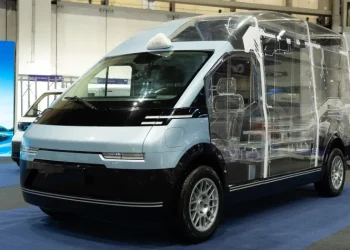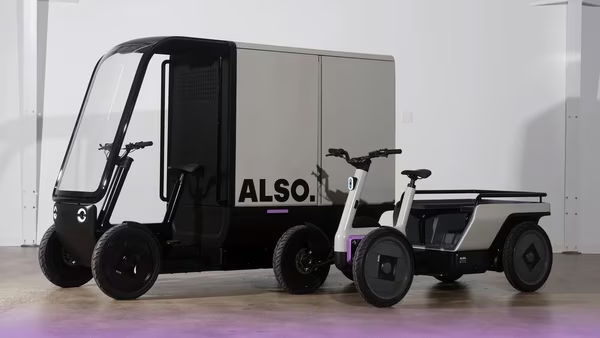
The new autonomous delivery EVs developed through ALSO and DoorDash represent a significant advancement in last-mile logistics. Furthermore, this strategic collaboration aims to deploy compact, purpose-built electric vehicles designed specifically for dense urban environments. Consequently, the partnership addresses critical challenges in navigating complex city infrastructure. Specifically, these vehicles target the “in-between” spaces such as bike lanes, curbsides, and road shoulders that conventional delivery vans often cannot access efficiently. Moreover, this innovation promises to reduce congestion while lowering emissions in metropolitan areas.
Additionally, ALSO’s compact autonomous delivery EVs are engineered from the ground up for autonomous operation rather than retrofitted from existing platforms. Therefore, performance optimization occurs specifically for real-world delivery scenarios involving tight navigation, frequent stops, and mixed-use infrastructure. Similarly, DoorDash views these vehicles as a key component in the future of logistics through its innovation arm. In fact, the goal centers on creating a seamless system that connects merchants, customers, and delivery networks more efficiently. Thus, both companies combine engineering expertise with logistics intelligence to accelerate market deployment.
Furthermore, the collaboration focuses on scaling both development and deployment of autonomous delivery EVs to meet growing urban demand. Consequently, high-density cities where traditional delivery methods face increasing limitations stand to benefit significantly. Moreover, this initiative addresses consumer expectations for faster, more reliable delivery services. Specifically, the partnership leverages ALSO’s EV engineering capabilities alongside DoorDash’s extensive logistics network. Therefore, scalable solutions reach market readiness more rapidly than either company could achieve independently.
Similarly, the announcement coincides with ALSO’s $200 million Series C funding round led by Greenoaks. Additionally, participation from Prysm Capital and a strategic investment from DoorDash strengthens financial backing for expansion. Furthermore, DoorDash Co-Founder Stanley Tang will join ALSO as a board observer as part of the agreement. Consequently, strategic alignment between both organizations deepens through shared governance and vision. Thus, decision-making processes benefit from direct input by key stakeholders invested in long-term success.
Moreover, ALSO plans to scale production and expand globally with vehicles capable of transporting both goods and people. Specifically, these platforms support both driven and autonomous modes to maximize versatility. Therefore, the partnership underscores a broader shift in the EV industry toward specialized, task-focused vehicles. Additionally, as cities evolve and demand for efficient delivery grows, compact autonomous delivery EVs could become a defining feature of urban mobility. In fact, this trend reflects changing consumer preferences and municipal priorities around sustainability and congestion management.
Furthermore, navigating the “in-between” spaces of urban infrastructure presents unique engineering challenges. Consequently, ALSO’s design philosophy prioritizes adaptability, small footprint, and intelligent navigation systems. Similarly, these attributes position the vehicles as practical solutions where larger delivery vans fall short. Moreover, by focusing on overlooked zones, the partnership aims to improve delivery efficiency while reducing environmental impact. Thus, cities benefit from decreased traffic congestion and lower carbon emissions from last-mile operations.
Additionally, the purpose-built nature of these autonomous delivery EVs enables optimized performance in complex scenarios. Specifically, frequent stops, tight turns, and mixed pedestrian-vehicle environments require specialized engineering. Therefore, ALSO’s ground-up design approach delivers advantages that retrofitted vehicles cannot match. Furthermore, DoorDash’s logistics expertise informs real-world use cases that shape vehicle development. Consequently, the resulting platforms align closely with merchant and customer expectations for reliability and speed.
Nevertheless, successful deployment depends on regulatory approval, public acceptance, and infrastructure compatibility. However, the strategic investment and partnership structure position ALSO and DoorDash to navigate these challenges effectively. Similarly, continuous testing, data collection, and iterative improvements will refine vehicle performance over time. Moreover, collaboration with municipal authorities and community stakeholders ensures responsible integration into urban environments. Therefore, the autonomous delivery EVs initiative balances innovation with practical implementation considerations.
Ultimately, this collaboration signals a pivotal moment in the evolution of last-mile logistics. Specifically, the convergence of AI, electric propulsion, and purpose-built design creates new possibilities for urban delivery. Consequently, merchants gain access to more efficient distribution channels while customers enjoy faster service. Furthermore, cities benefit from reduced congestion and emissions as autonomous delivery EVs replace larger, less efficient vehicles.
Thus, the ALSO DoorDash partnership exemplifies how strategic alliances drive meaningful progress in sustainable urban mobility. Additionally, ongoing innovation in vehicle capabilities and logistics integration will shape the next chapter of delivery infrastructure. Therefore, stakeholders across the ecosystem stand to gain from this forward-looking approach to urban transportation challenges. Ultimately, thoughtful engineering combined with strategic partnership creates enduring value for communities, businesses, and the environment alike. Consequently, autonomous delivery EVs represent more than a technological advancement, they embody a commitment to smarter, cleaner, and more accessible urban logistics for the future.