The Delivan UK launch marks a bold entry into one of Europe’s most competitive commercial vehicle markets. Already, the brand has confirmed plans to debut in the United Kingdom with a range of vans, logistics solutions, and advanced delivery technologies. As a result, Chery Holding Group is positioning Delivan as a serious challenger to established players.
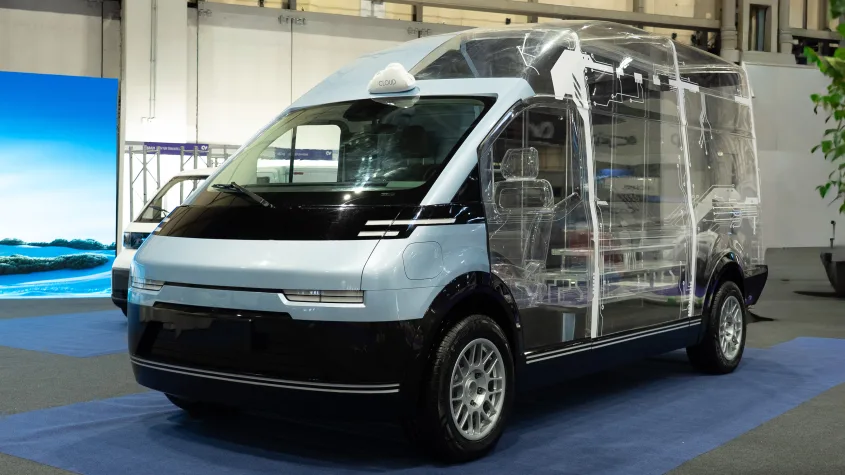
Notably, the Delivan UK launch was introduced at the Commercial Vehicle Show in Birmingham. There, the company unveiled its “intelligent mobility show vehicle,” which previews a mid-size electric van. Consequently, this model is expected to compete directly with leading electric vans such as the Ford E-Transit Custom, Vauxhall Vivaro Electric, and Renault Trafic E-Tech.
Unlike many rivals, the Delivan concept adopts a clean and futuristic design. For example, while competitors often mirror traditional combustion vans, Delivan takes a different path. Its flat side panels simplify production and reduce costs. At the same time, the minimalist front design features slim headlights and a flat nose. Therefore, the vehicle stands out visually while improving efficiency.
In addition, body-coloured wheel covers are designed to enhance aerodynamics. As a result, the van could achieve better energy efficiency compared to conventional designs. Although full technical specifications remain undisclosed, the company has confirmed a modular platform. This means buyers can expect multiple configurations, including different roof heights and a double-cab option.
However, the success of the Delivan UK launch will depend heavily on performance. Currently, leading electric vans offer over 200 miles of range on a single charge. Therefore, Delivan must match or exceed that benchmark to compete effectively. Without that capability, it may struggle to attract fleet buyers who prioritize reliability and range.
Beyond the vehicles themselves, the Delivan UK launch includes a suite of fleet services. These services, branded as ‘Pro’, ‘X’, and ‘I’, aim to support businesses in managing their operations. For instance, they will cover maintenance, vehicle customization, and logistics solutions. Consequently, Delivan is positioning itself as more than just a manufacturer. It is presenting a full-service ecosystem for commercial clients.
According to Jolly Yang, Vice President of Chery Commercial Vehicle and CEO of Delivan, the expansion is strategic. He described Europe as one of the most demanding commercial vehicle markets. Therefore, entering the region provides an opportunity to showcase the company’s technology and long-term vision. His remarks highlight the importance of the Delivan UK launch as a gateway into Europe.
At the same time, Chery’s corporate structure has evolved to support this move. The company separated its passenger car division in 2025. As a result, Chery Commercial Vehicle now focuses on brands like Delivan. This shift allows for more targeted investment and faster development in the commercial segment.
Importantly, the Delivan UK launch benefits from Chery’s broader global experience. The group has already found success with passenger brands such as Omoda and Jaecoo. Therefore, it brings both manufacturing scale and distribution knowledge into the commercial vehicle space. This advantage could help Delivan establish itself quickly in the UK market.
Even so, some uncertainty remains around powertrain options. While Delivan emphasizes electrification, it has not confirmed whether it will offer hybrid models. This decision will be crucial. On one hand, a fully electric lineup aligns with regulatory trends. On the other hand, hybrid options could appeal to businesses transitioning gradually.
Meanwhile, the timing of the Delivan UK launch is significant. Governments across Europe continue to tighten emissions standards. As a result, demand for electric commercial vehicles is rising. Fleet operators are under pressure to reduce carbon footprints while maintaining efficiency. Therefore, new entrants like Delivan have a clear opportunity to gain traction.
Nevertheless, competition remains intense. Established brands such as Ford and Volkswagen dominate the segment. They benefit from strong customer loyalty and extensive service networks. Consequently, Delivan must prove both reliability and value to win market share.
Looking ahead, the Delivan UK launch is expected to culminate in a full market entry by 2027. By then, the company aims to offer a complete lineup of commercial solutions. If executed effectively, this strategy could disrupt the current market balance.
Ultimately, the Delivan UK launch represents more than a new product introduction. It signals a broader shift as Chinese manufacturers expand into Europe’s commercial vehicle sector. The outcome will depend on performance, pricing, and customer trust. However, if Delivan delivers on its promises, it could become a notable force in the next phase of electric mobility.