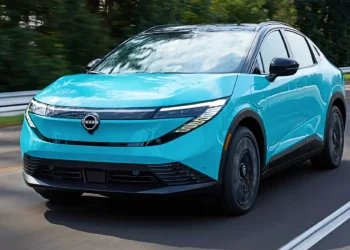
The third-generation Nissan Leaf is on its way, promising a bold evolution of one of the world’s most recognized electric vehicles. Nissan, a pioneer in mainstream EVs, is preparing to debut the new model later this month. The carmaker has released early details showcasing a blend of efficiency, smart design, and functional innovation aimed at both legacy and future-conscious drivers.
Nissan’s EV Legacy Continues
Since the original Nissan Leaf launched in 2010, the model has become a staple in the global electric car landscape. With nearly 700,000 units sold and around 28 billion kilometers driven, the Leaf helped prove electric vehicles weren’t just concept cars—they were road-ready.
Now, Nissan wants the third-generation Nissan Leaf to do more than just uphold that legacy. It aims to directly challenge combustion-engine vehicles with improvements in range, performance, and family-friendly comfort.
Aerodynamic Design for Greater Efficiency
A standout feature of the third-generation Nissan Leaf is its aerodynamic performance. The U.S. and Japan variants feature a drag coefficient (Cd) of 0.26, while the European versions go even further with a Cd of 0.25, thanks to unique wheels and mirror designs.
Lower drag means less resistance, which leads to better energy efficiency and increased driving range. Nissan’s engineers used various techniques to achieve this, including:
- Flush door handles
- An active grille shutter
- Sleek wheels
- A flat underfloor
- A sculpted fastback silhouette
These features work together to reduce air turbulence and make the car glide more efficiently at highway speeds.
Smart Roof, Smarter Cabin
The new panoramic glass roof is more than just a luxury detail. It plays a role in the Leaf’s improved aerodynamics by allowing Nissan to lower the car’s height by 12 mm at key air detachment points—without sacrificing headroom.
The roof also includes electrochromic glass technology, which lets passengers adjust the transparency to control sunlight and visibility. This eliminates the need for traditional sunshades that often reduce cabin space. An infrared-reflective coating helps block out heat, keeping the cabin cooler and improving overall energy efficiency.
Built on the CMF-EV Platform
The third-generation Nissan Leaf is built on the CMF-EV platform, which Nissan designed specifically for electric vehicles. This flexible platform allows for a completely flat cabin floor, replacing the transmission tunnel found in combustion-engine vehicles.
As a result, the interior feels spacious and open, making it more comfortable for both drivers and passengers. It also improves layout options for seating and storage, which is vital for a car positioned as a family EV.
More Than a Tease: A Confident Step Forward
Nissan’s careful focus on practicality and design signals that the third-generation Nissan Leaf isn’t just another refresh. The company wants this vehicle to stand confidently alongside both EV and traditional vehicle competitors in the compact segment.
With the official reveal approaching, the early glimpses indicate a well-balanced car that improves upon its predecessor in nearly every way. The original Leaf earned a place in automotive history by doing what other companies didn’t dare—offering a mass-market electric car when few believed in the segment.
Now, the third-generation Nissan Leaf faces a more crowded market but enters it with deeper experience and sharper innovation. If it delivers on these early promises, Nissan might once again redefine what a mainstream electric car can be.
READ: 2025 Nissan Sakura Tops List as Cheapest EV on the Market