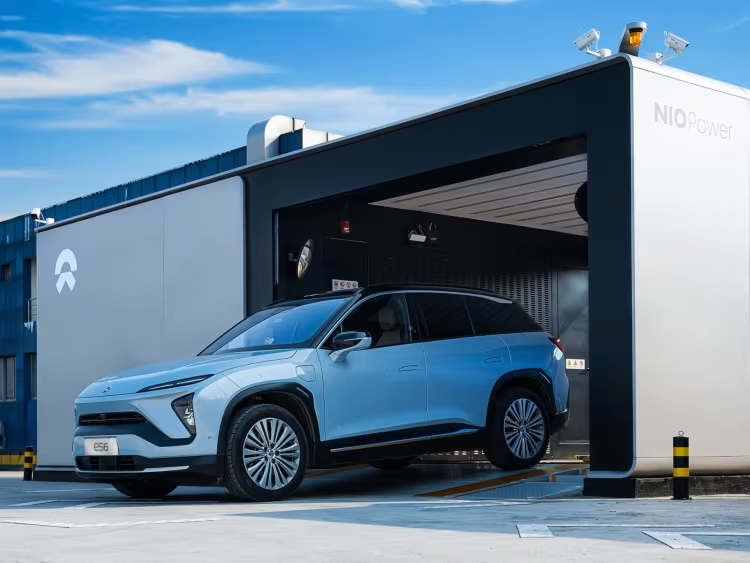
The Nio battery swap system achieved a historic milestone this February. China’s Autohome reported that Nio processed a record 146,649 battery swaps in a single day on February 15. This unprecedented volume underscores the growing viability of battery swapping as an alternative to conventional charging methods. Source: Autohome industry report and Nio official communications.
Battery swap stations allow electric vehicles to enter a facility and receive a fully charged battery in place of a depleted one. This process eliminates the extended waiting periods typically associated with traditional charging stations. Nio states that swaps take approximately three minutes to complete. Consequently, this method proves 15 to 25 minutes faster than fast-charging a Tesla Model 3 from 10 to 80 percent under optimal conditions.
The company recently surpassed 100 million cumulative battery swaps. This achievement suggests the system represents a sustainable solution to EV charging challenges. Swapped batteries undergo thorough inspection before recharging and returning to service. Nio currently operates more than 8,600 charging and battery-swapping stations across China. This extensive network supports the company’s diverse vehicle lineup, which ranges from crossovers to sedans like the ET9.
China’s leadership in EV infrastructure development becomes evident through these metrics. The Nio battery swap model demonstrates scalability that other markets have yet to replicate. Policy support, market structure, and economic factors drive this divergence more than technical limitations. Consequently, understanding these contextual differences helps explain varying adoption rates worldwide.
The United States continues pursuing fast-charging station expansion as its primary infrastructure strategy. Companies like Electrify America, ChargePoint, and EVgo grow their networks nationwide. These efforts address range anxiety and build consumer confidence in electric vehicle adoption. However, battery swap stations remain largely limited to startup projects within the U.S. market.
Tesla previously experimented with a small battery-swap pilot program. The company later abandoned this effort to focus on expanding its Supercharger network. San Francisco-based Ample Inc. also championed swap technology but filed for bankruptcy in December 2025. These outcomes highlight the challenges of implementing alternative charging models in different regulatory and economic environments.
The Nio battery swap process offers distinct practical advantages for EV owners. Three-minute completion times significantly reduce downtime compared to conventional charging. This efficiency proves particularly valuable for commercial fleets and long-distance travelers. Furthermore, the system reduces pressure on electrical grids during peak demand periods.
Battery health management represents another significant benefit. Swapped batteries undergo systematic inspection and maintenance at dedicated facilities. This centralized care extends battery lifespan and ensures consistent performance standards. Additionally, the model enables battery-as-a-service offerings that lower upfront vehicle costs for consumers.
User experience improvements extend beyond speed. Swap stations provide predictable, consistent service regardless of weather conditions or grid capacity. Drivers avoid the uncertainty of finding available charging ports during travel. Consequently, the Nio battery swap system enhances overall EV ownership satisfaction through reliability and convenience.
Nio’s operational scale demonstrates the technical feasibility of widespread battery swapping. The company’s network of over 8,600 stations supports millions of successful transactions annually. This infrastructure investment reflects long-term commitment to the technology’s potential. Furthermore, continuous innovation in automation and logistics improves station efficiency over time.
The 100 million swap milestone provides valuable data for future development. Usage patterns inform optimal station placement and battery inventory management. Additionally, performance metrics guide engineering improvements for next-generation swap systems. Consequently, each transaction contributes to refining the overall user experience and operational efficiency.
Market expansion opportunities exist beyond China’s borders. European and Asian markets show growing interest in alternative charging solutions. However, successful replication requires adapting to local regulations, consumer preferences, and infrastructure constraints. Therefore, the Nio battery swap model’s global potential depends on strategic partnerships and policy alignment.
Fast-charging networks and battery swapping represent complementary rather than competing approaches. Each model serves different use cases and consumer preferences effectively. Fast charging excels for overnight home charging and opportunistic top-ups during daily routines. Battery swapping proves advantageous for time-sensitive scenarios and fleet operations requiring rapid turnaround.
Economic considerations influence infrastructure investment decisions significantly. Fast-charging stations require substantial electrical infrastructure but offer simpler deployment mechanics. Battery swap stations demand higher initial capital for automation systems and battery inventory. However, they generate recurring revenue through swap fees and battery leasing programs.
Policy frameworks shape infrastructure development trajectories profoundly. China’s coordinated approach enables rapid deployment of standardized swap stations. Conversely, the U.S. market’s fragmented regulatory environment complicates large-scale infrastructure projects. Therefore, the Nio battery swap system’s success reflects supportive policy conditions as much as technical merit.
Consumer education remains crucial for technology adoption. Many EV buyers remain unfamiliar with battery swapping concepts and benefits. Clear communication about safety, convenience, and cost advantages builds market acceptance. Additionally, demonstrating real-world performance through pilot programs accelerates consumer confidence.
The evolution of EV infrastructure continues shaping transportation’s future. The Nio battery swap milestone highlights innovation’s role in addressing adoption barriers. As technology matures and markets evolve, diverse charging solutions will likely coexist to serve varied consumer needs. Ultimately, expanding accessible, reliable charging options accelerates the global transition to sustainable mobility.