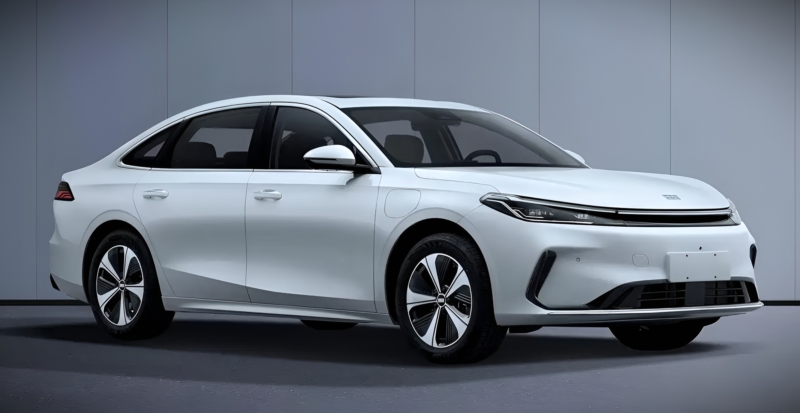
The Geely Galaxy A7 EV has appeared in China’s Ministry of Industry and Information Technology catalogue. This filing confirms that Geely is launching its first fully battery-electric version of the mid-size sedan. Moreover, it signals a clear expansion of the Galaxy A7 lineup beyond plug-in hybrids.
According to the documents, the Geely Galaxy A7 EV uses a single electric motor rated at 160 kW—roughly 215 horsepower. Although Geely has not yet disclosed the battery capacity or driving range, the company will equip the vehicle with a lithium iron phosphate (LFP) pack. This choice enhances safety, durability, and affordability, which aligns well with Geely’s mainstream strategy.
Design changes clearly mark the car as electric. For instance, the front grille is fully closed. Vertical elements now appear in the fog-lamp area, and they likely aid airflow or cooling. Additionally, engineers placed the charging port on the right front fender. As a result, drivers can charge more easily at curbside stations.
Dimensionally, the Geely Galaxy A7 EV measures 4,935 mm long, 1,905 mm wide, and 1,500 mm tall, with a 2,845 mm wheelbase. Compared to the plug-in hybrid, it is 17 mm longer and 5 mm taller, while sharing the same wheelbase. These slight increases may improve cabin space or support the battery layout.
At the rear, designers gave the EV a new full-width tail-light bar. The lighting pattern differs from the hybrid model, helping buyers distinguish the all-electric version at a glance. Even so, it retains the sedan’s familiar silhouette while adding a contemporary flair.
Geely lists two wheel and tire options: 215/60 R17 and 225/55 R18. Therefore, customers can expect multiple trim levels at launch. They will be able to choose between comfort-oriented or sportier configurations.
To provide context, the plug-in hybrid Galaxy A7 launched in 2025. It runs on Geely’s GEA global intelligent new energy architecture. By combining a 1.5-liter engine with electric motors, it achieves over 2,100 km of total range. Now, the Geely Galaxy A7 EV targets urban drivers who prefer a simpler, fully electric experience—especially where charging infrastructure is strong.
Importantly, Geely has not announced a launch date, pricing, battery size, or official range figures. Nevertheless, the MIIT registration strongly suggests production is imminent. In fact, this document serves as the first official technical confirmation of the model.
In summary, the Geely Galaxy A7 EV fits strategically into Geely’s electrification roadmap. It delivers a spacious, modern electric sedan built on a proven platform. With this move, Geely aims to compete more directly with BYD, NIO, and Tesla in China’s competitive mid-size EV segment. While details remain limited, this model could become a cornerstone of Geely’s 2026–2027 product offensive.
READ: All-New Chery QQ3 EV Opens for Pre-Orders With Up to 401 km Range