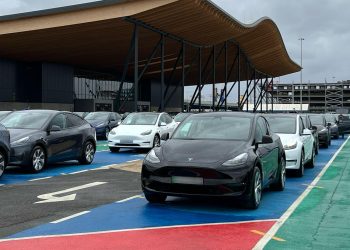
Tesla has officially launched its highly anticipated Robotaxi service in Austin, Texas, marking a significant milestone in the company’s journey toward fully autonomous vehicles. For the first time, Tesla is offering self-driving rides without the need for a human safety monitor inside the car. The announcement was made by Elon Musk himself, who confirmed the rollout via a post on X (formerly Twitter), saying, “Just started Tesla Robotaxi drives in Austin with no safety monitor in the car. Congrats to the @Tesla_AI team!”
The introduction of unsupervised Robotaxi rides represents a leap forward from the company’s initial tests in Austin last year, where a human safety monitor was present in the passenger seat during rides. Previously, in the California Bay Area, Tesla’s robotaxi fleet still had safety drivers behind the wheel. The move to driverless rides without a monitor inside the car signifies Tesla’s growing confidence in its autonomous driving technology.
A Long-Awaited Milestone in Self-Driving Technology
While Tesla’s self-driving ambitions have long been promised, this launch marks a crucial moment in the evolution of autonomous vehicles. Elon Musk had initially predicted Tesla would have 1 million robotaxis in operation by 2020, but the technology has faced multiple delays. However, despite being a few years behind schedule, this new Robotaxi rollout is seen as a monumental achievement for the company. Musk’s vision for a fully autonomous ride-hailing service is now taking shape, with passengers being able to hail driverless Teslas via the Tesla app.
Despite the delay, Tesla’s Robotaxi service is a game-changer, offering self-driving rides without a safety driver inside, a feat that only a few other companies, like Waymo, have achieved. The next question for Tesla is how quickly it can scale this service and roll it out to new cities.
Scaling the Robotaxi Network: The Challenges Ahead
As Ashok Elluswamy, Tesla’s head of autonomous vehicle program, explained, the rollout of unsupervised Model Ys will initially be slow. The company plans to mix a few unsupervised vehicles with its existing Robotaxi fleet, which still includes safety monitors. Over time, the ratio will increase, bringing more self-driving vehicles into operation.
Tesla’s plans include the production of steering-wheel-free Cybercabs by April 2026 to help expand the Robotaxi network. These vehicles, which are essentially Model Ys with Full Self-Driving software, will be integral to scaling Tesla’s service in the coming months. However, one of the biggest challenges remains the competition from Waymo, a subsidiary of Alphabet, which is already a leader in autonomous driving technology.
Waymo vs Tesla: The Race for Autonomous Dominance
As Waymo continues to lead the charge in autonomous driving, offering 450,000 paid rides per week in six cities, Tesla will need to scale rapidly to catch up. While Waymo uses a combination of sensors, including lidar and radar, Tesla’s camera-only approach to autonomous driving has faced scrutiny. Despite this, Musk remains confident in the technology, and Tesla’s full self-driving capabilities are becoming more advanced with each software update.
Waymo’s expansion plans are impressive, with new launches in Miami and at least 20 more cities planned for 2026. Tesla, however, is focused on mass adoption of self-driving technology, which it hopes to integrate into every Tesla vehicle and allow owners to use the technology for personal rides or to operate them as part of the Robotaxi fleet.
The Future of Tesla’s Self-Driving Vision
The next significant milestone for Tesla will be making the Robotaxi service available to the public at large, allowing individuals to access autonomous rides in Tesla vehicles. While Musk has already introduced the technology in Austin, the broader rollout of fully self-driving Tesla cars will be a monumental task that will require overcoming various regulatory, technological, and safety hurdles.
Tesla’s vision of autonomous cars remains ambitious, with plans to allow car owners to generate income by using their Tesla vehicles as part of the Robotaxi network. If successful, this will radically change how people use and think about cars.