Alpitronic EV chargers are transforming the U.S. fast-charging landscape. Known as Europe’s top EV charging hardware provider, Alpitronic now rapidly expands across the United States. It supplies high-powered charging units to major networks like Electrify America, Walmart, and Mercedes-Benz High Power Charging. While Tesla continues to lead, Alpitronic has become a serious rival in hardware performance and reliability.
Within a year, Alpitronic grew its U.S. public fast-charger hardware share from zero to 12%, according to Paren. That places it just behind Tesla at 36%, and ahead of ChargePoint and BTC Power. Unlike Tesla, which builds and operates its entire network, Alpitronic focuses solely on making top-tier chargers while letting partners handle deployment.
Its strong track record in Europe accelerated its entry into the U.S. Clients like Ionity and Fastned encouraged the move, and Alpitronic responded. It launched its U.S. headquarters in Charlotte in 2023 and opened a manufacturing facility in Wisconsin.
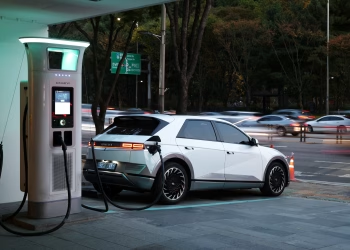
The real momentum came from its partnership with Ionna—a consortium formed by GM, Toyota, Stellantis, Hyundai, and others. Ionna’s upscale “Rechargery” stations use only Alpitronic’s HYC 400 chargers. These units deliver up to 400 kW and support both CCS and NACS connectors, making them highly versatile for the evolving U.S. market.
Alpitronic EV chargers shine because of their clean design, efficient energy delivery, and advanced software. Each charger features dual cables, a top-mounted dispenser system, and a touchscreen interface that displays live charging curves, speeds, and pricing.
The chargers connect to Alpitronic’s backend system, which enables remote diagnostics, over-the-air updates, and real-time monitoring. Technicians resolve many issues remotely. If physical repairs are needed, the system pinpoints the faulty component before dispatch, reducing downtime.
The company also uses silicon carbide modules, which cut energy loss and heat generation. Its HYC 400 chargers achieve 97.5% efficiency—meaning drivers receive nearly all the energy they pay for, rather than losing it through transmission or heat. That gives Alpitronic a competitive edge in both performance and operational cost.
Despite their rapid rise, Alpitronic has not shared the exact number of chargers deployed or uptime statistics. However, President Mike Doucleff confirmed the company now installs chargers by the thousands. “We’ve scaled from dozens to hundreds to thousands in no time—and we’re just getting started,” he said.
Skeptics question whether Alpitronic’s units will endure America’s extreme climates. But the company’s chargers already work reliably across Europe, from freezing Finland to sunny Spain. Supporters argue that if they perform well in those conditions, they can succeed in the U.S. too.
Alpitronic EV chargers now appear at Walmart, Ionna Rechargeries, and luxury-branded stations. Retailers and automakers see value in combining brand trust with charging quality. They know customers driving premium EVs won’t accept faulty charging experiences.
Tesla still holds the lead through its vertically integrated Supercharger network. But Alpitronic is carving a powerful niche by focusing on high-efficiency hardware and top-tier partnerships. With over 86,000 global stalls—already more than Tesla’s 70,000—Alpitronic has momentum.
America’s EV transition needs reliable infrastructure. As federal subsidies decline and charging networks compete on quality, companies like Alpitronic may drive the next wave of EV adoption.