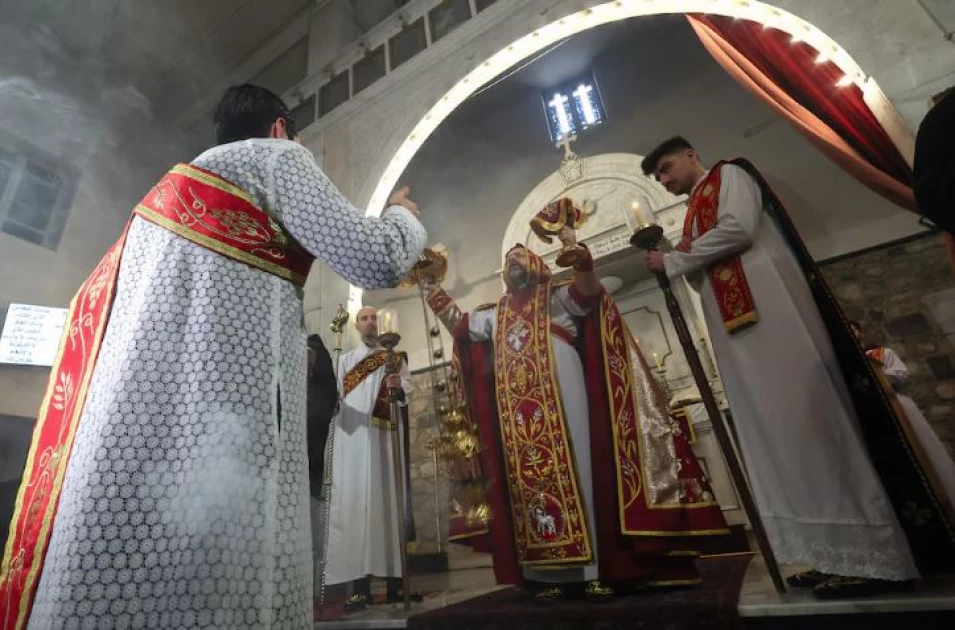
As the Christmas season approaches, Syria’s Christian community finds itself in a state of anxiety and caution under the leadership of Hayat Tahrir al-Sham (HTS), an Islamist group that has recently consolidated power in parts of the war-torn country. Despite reassurances from HTS leaders that religious minorities, including Christians, are free to practice their faith, church leaders have advised their congregations to scale back Christmas celebrations. This decision reflects the deep-seated mistrust of the new rulers, rooted in decades of brutal dictatorship and the scars left by Syria’s devastating 13-year civil war.
A New Islamist Leadership Attempts to Build Trust
Ahmed al-Sharaa, the de facto ruler of HTS, has made efforts to present a more inclusive image of his government. Once a prominent figure in the Sunni Islamist group, Sharaa has traded his jihadist uniform for business suits, signaling a shift in approach. He has assured Christians and other minorities that they will be safe under HTS rule, and has pledged not to seek revenge against members of Bashar al-Assad’s Alawite-dominated former regime or to repress any other religious groups.
Sharaa’s assurances, however, have done little to assuage the fears of Syria’s Christian population. Many remain unconvinced of HTS’s commitment to fostering a civil society that respects and protects its diverse religious and ethnic communities. The group’s history as a former al-Qaeda affiliate only deepens the skepticism, with many viewing its recent promises as a strategic facade.
Incidents Stoke Fear Among Christians
Recent incidents have further heightened concerns. On December 18, unidentified gunmen targeted a Greek Orthodox church in the city of Hama. They fired shots at the compound, attempted to destroy a cross, and vandalized gravestones in the church’s cemetery. While HTS authorities quickly arrested the perpetrators, the attack left a lasting impression on the community.
In Damascus, the predominantly Christian neighborhood of Bab Touma was rattled by SUVs blaring jihadist songs through loudspeakers. Residents reported seeing an armored vehicle in a Christian quarter with the ominous message “Your day is coming, Oh worshippers of the cross” scrawled across its front window. Though HTS forced the driver to remove the sign and issue an apology, the incidents have done little to reassure Syria’s Christians.
Bishop Andrew Bahhi of St. George’s Syriac Orthodox Church expressed the community’s unease. “The community is watching to see if the groups currently in power are genuinely committed to establishing a civil society that offers equal opportunities for all,” he said. While Bahhi acknowledged HTS’s swift response to the incidents, he underscored the lingering mistrust and fear within the Christian community.
Decades of Trauma Weigh Heavily
The deep scars left by Syria’s civil war are evident in the lives of its Christian population and other minorities. For many, the trauma of persecution and violence remains fresh. Syria’s Christian community includes diverse groups such as Syriac, Greek, and Armenian Orthodox Christians, who have long coexisted with the country’s Muslim majority. However, the civil war heightened fears that Sunni Islamist rule would imperil their traditions and way of life.
Emilia Katarina, a Christian woman from Damascus, embodies the anguish felt by many in her community. She lost her eldest son and husband during the war. Her son, Firas, disappeared in 2012 after being detained by Assad’s forces while on his way home. Two years later, her husband was killed when a shell from the Jaish al-Islam rebel group exploded near their home, injuring Emilia and her daughter, Mary.
“Whenever I hear a sound at night, I jump. Fear is deeply ingrained in us,” Emilia said, sitting near a portrait of her husband wrapped in the Syrian flag. Clutching a photograph of her missing son, she added, “The ideology does not change in an hour.” Her daughter echoed the sentiment, saying, “We are afraid of this ideology.”
HTS’s Mixed Messages
Despite these fears, HTS has attempted to open a dialogue with Christian leaders. Shortly after the fall of the Assad regime, an HTS representative met with Bishop Bahhi and other Christian leaders, urging them not to be afraid. Yet, the sincerity of these overtures remains questionable. “How truthful and serious he is? We don’t know,” said Bahhi.
Even if HTS succeeds in building some trust, Christians fear a myriad of other armed Islamist groups operating in Syria, many of which harbor extremist ideologies. The presence of heavily armed, bearded men patrolling the streets of Damascus does little to inspire confidence among the Christian population.
Restrictions on Christmas Festivities
To ensure safety, church leaders like Bishop Bahhi are urging Christians to take precautions this Christmas. He has advised young people to dress modestly, keep images of Father Christmas and St. Nicholas within church premises, and avoid distributing sweets on the streets as part of traditional celebrations. These measures reflect the community’s cautious approach to navigating life under Islamist rule.
The subdued celebrations also serve as a reminder of the fragility of religious coexistence in Syria. For Christians like Emilia, even attending church can be fraught with anxiety. At St. George’s Church, as Bishop Bahhi delivered a sermon encouraging faith during challenging times, Emilia lit a candle and whispered a prayer. “Maybe God will answer my prayers and bring back my son,” she said, her voice trembling with emotion.
A Fractured Nation’s Uncertain Future
Syria’s ethnic and religious mosaic—encompassing Christian minorities, Muslim Kurds, Alawites, Shi’ites, and the Druze community—faces an uncertain future under HTS rule. Decades of dictatorship and the devastating civil war have left deep divisions, and the task of rebuilding trust among these communities is monumental.
As Christmas approaches, Syria’s Christians remain wary, torn between hope for a more inclusive society and the harsh realities of their recent past. For now, the bells of Damascus’s ancient churches ring softly, a poignant reminder of a community striving to preserve its faith and identity amid fear and uncertainty.