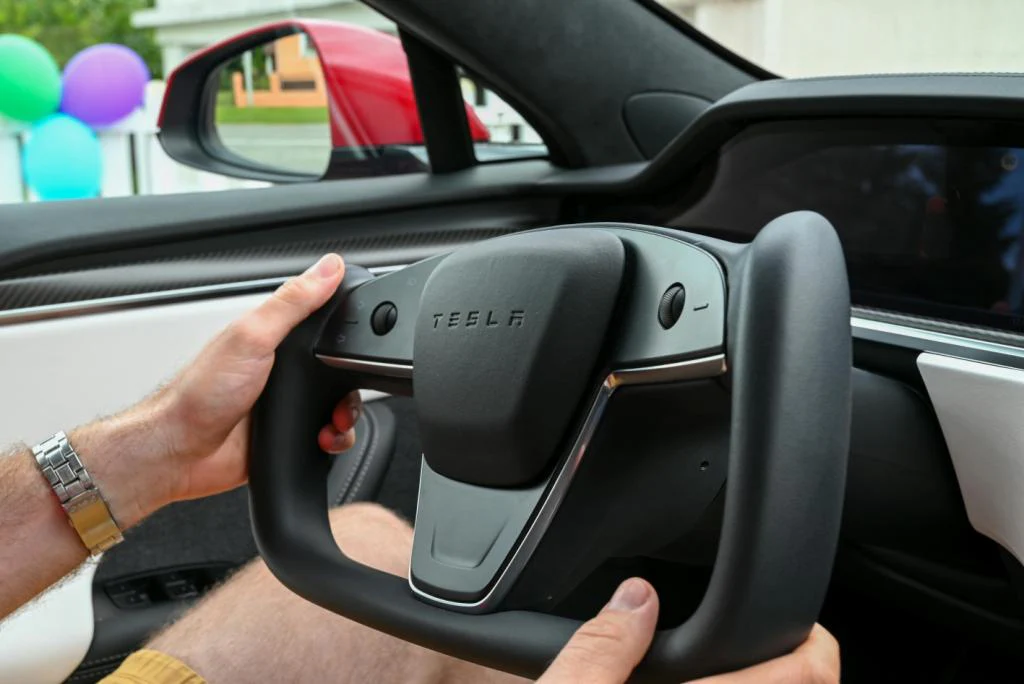
Yoke steering wheels once symbolized futuristic electric vehicle design. However, China will now ban them due to serious safety concerns. A new regulation takes effect on January 1, 2027. Consequently, these non-circular steering systems will disappear from the world’s largest auto market. Clearly, safety now outweighs style.
China’s Ministry of Industry and Information Technology issued the updated standard GB 11557-202X. This replaces a 2011 version with much stricter rules. Importantly, it removes all special allowances for half-steering or yoke-style designs. As a result, manufacturers can no longer certify yoke steering wheels for road use.
The main issue lies in crash testing. Specifically, the new rules require impact tests at ten precise points on the steering wheel. One critical point sits at the very top center. Traditional circular wheels have material there. In contrast, yoke steering wheels do not. Therefore, they fail the test before physical evaluation even begins.
This problem reflects real-world dangers. According to safety data, 46% of driver injuries in frontal crashes come from contact with the steering system. Normally, a full circular wheel cushions the chest and head during sudden stops. Yet the open top of a yoke steering wheel leaves a large gap. Because of this, drivers can slide through and strike the dashboard or windshield. Thus, the risk of severe injury rises significantly.
Airbag deployment adds another layer of concern. Airbags inflate in milliseconds with explosive force. Moreover, the new law bans any hard fragments—metal or plastic—from flying toward the driver during deployment. Yoke steering wheels have unusual shapes and uneven support structures. These components can break unpredictably when the airbag fires. Since regulators could not guarantee their integrity, certification became impossible under the new rules.
Several automakers embraced this trend. For example, Tesla introduced yokes in its Model S and Model X. Similarly, Chinese brands like IM Motors and Jiyue adopted them in premium models. Now, however, they must act quickly. All new models must comply with GB 11557-202X by January 1, 2027. Although existing models may receive a short grace period, future vehicles will almost certainly return to circular steering wheels.
China leads global EV sales. Given its market size, regulatory decisions here often influence other regions. Therefore, this move may prompt safety reviews worldwide. In turn, the global appeal of yoke steering wheels could fade fast.
Innovation should never compromise safety. Admittedly, yoke steering wheels looked sleek and modern. Nevertheless, they failed in critical crash scenarios. Ultimately, the steering wheel of the future may look old-fashioned. But that simple circle offers proven protection when it matters most.
READ: BYD Denza Z9 and Z9GT to Offer Over 1,000 km Range with New Batteries