Americans Prioritize Range and Charging Time Over Cost
The end of the federal clean-vehicle tax credit led to a decline in EV market share, showing that price matters a lot. However, a new study found that Americans are more concerned with range and charging time than cost when it comes to electric vehicles (EVs), and these factors are more likely to influence their hesitation in adopting EVs.
Deloitte’s 2026 Global Automotive Consumer Study, which surveyed over 28,500 people from 27 countries between October and November 2025, revealed that 47% of Americans listed EV range as their top concern, keeping them from buying an EV. Charging time followed closely, with 44% citing it as a barrier. Only 40% of respondents said cost was a significant concern.
Read Also
Karma Revero: A Look at the Luxury Electric Brand
Tesla Cybertruck: The All-Electric Pickup Revolution
Extended Range EVs: A New Era of Electric Vehicles
EV purchase intent has only risen slightly in the U.S. in 2025, from 5% to 7%, compared to 2024, while interest in pure combustion and hybrid vehicles remained stable at 61% and 26%, respectively. This indicates that, while the federal tax credit’s removal has slowed EV adoption, Americans are still considering the switch, especially due to EVs’ lower running costs.
EV Adoption and Charging Challenges
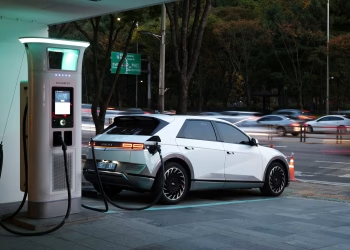
One of the biggest hurdles to broader EV adoption is home charging access. While 77% of respondents plan to charge their EVs at home, 53% reported not having access to a dedicated home charger. This limitation can significantly affect the convenience of owning an EV.
Although the lower operating costs are a significant draw for EV buyers, many are cautious about jumping into electric car ownership without a dependable home-charging solution.
The Bottleneck: Rural Charging Infrastructure
Americans who are considering EVs are pragmatic. They need their EVs to meet their real-world driving needs, especially in rural areas. Charging infrastructure in these regions remains underdeveloped. This is especially true for those who need long-range EVs for towing or road trips.
With more affordable models, such as the Chevrolet Bolt, Equinox EV, Nissan Leaf, and Tesla Model 3, now available, these concerns can be mitigated for many buyers. However, there is still a gap in the infrastructure required to support widespread EV adoption.
Loyalty to Brands and EV Features
The study also found that 53% of respondents plan to switch brands for their next vehicle. When making a decision, 58% prioritized quality, 51% looked for performance, and 46% focused on price. This shows that quality remains a top factor in brand choice, despite growing interest in EVs.
Additionally, 62% of consumers expressed interest in over-the-air updates, showing that software-defined vehicles are gaining traction as a desirable feature. This highlights the growing demand for more advanced, tech-savvy vehicles that improve over time.
Looking Ahead: The Future of EVs in the U.S.
Though the loss of the federal tax credit initially slowed down EV sales, the long-term outlook for EVs in the U.S. remains positive. As more affordable EVs come to market and charging infrastructure continues to improve, Americans will likely prioritize range, charging time, and cost-effectiveness when choosing their next vehicle. With improvements in battery technology and government support for EV infrastructure, electric vehicles are poised to gain more traction.