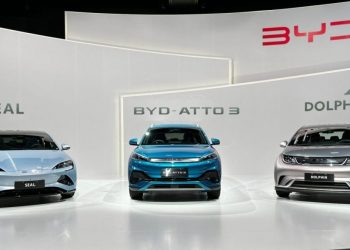
In a major shift within the electric vehicle (EV) market, China’s BYD has officially surpassed Tesla as the world’s largest seller of electric vehicles, marking the first time the Chinese automaker has outpaced its American rival in annual sales. This milestone highlights the growing competition in the global EV market, especially from Chinese manufacturers, who are increasingly putting pressure on established players like Tesla.
BYD’s Surge to the Top
For the year 2025, BYD reported a nearly 28% increase in its EV sales, reaching over 2.25 million vehicles sold. In contrast, Tesla’s sales dropped by nearly 9% to 1.64 million vehicles, marking the second consecutive year of declining sales for the electric car giant.
The surge in BYD’s sales is attributed to the company’s ability to offer a wide range of electric models at competitive prices, making it a dominant player in the global EV market. As a result, it has now emerged as the largest EV seller, not just in China, but globally.
Tesla Faces Multiple Challenges
Tesla’s drop in sales has been a result of several factors. In the last quarter of 2025, Tesla’s car sales fell by 16%, partly due to the repeal of a government subsidy in the U.S. that had helped reduce the cost of certain battery electric and plug-in hybrid vehicles by as much as $7,500. This subsidy removal directly impacted consumer demand for Tesla’s vehicles, especially in its key markets.
Additionally, Tesla is facing increased competition from other Chinese manufacturers like Geely and MG, which have been able to undercut Tesla’s prices, making EVs more accessible to a broader range of customers. Tesla responded by launching lower-priced versions of its best-selling models, such as the Model 3 and Model Y, in an attempt to boost sales, particularly in the U.S. market.
Elon Musk’s Challenge and Tesla’s Long-Term Plans
Despite these challenges, Tesla remains a highly profitable company, outpacing many of its competitors in terms of revenue and market value. However, for Elon Musk, Tesla’s CEO, the road ahead is increasingly complex. In 2025, Musk’s compensation package, approved by Tesla’s shareholders, could lead to a payout of up to $1 trillion if certain targets are met. These targets include significantly increasing Tesla’s sales and market value over the next decade, which could be a tough challenge considering the growing competition.
Musk’s attention is divided across several ventures, including SpaceX, X (formerly Twitter), and The Boring Company. Some investors have expressed concern that his focus on these other ventures might be diverting attention away from Tesla. Musk has since stepped back from his role in the U.S. government, where he briefly led the Department of Government Efficiency (Doge) under former President Donald Trump.
Despite the questions surrounding Musk’s divided interests, there remains optimism that Tesla’s future lies in its robotaxi and self-driving technology. Some analysts predict that Tesla will capture around 70% of the self-driving market over the next decade, largely due to its unmatched scale and technology. However, the road to achieving this goal is uncertain, and much depends on how well Tesla can scale these technologies.
BYD’s International Expansion
Though BYD has emerged as the top EV seller globally, its growth rate slowed in 2025, marking its weakest performance in five years. The slowdown is attributed to fierce competition within China, its home market. However, BYD has aggressively expanded into international markets, including Latin America, Southeast Asia, and parts of Europe. This expansion has been crucial to its rise as the top EV seller, even as Chinese EVs face steep tariffs in certain countries.
In the UK, for example, BYD’s sales surged by an astonishing 880% in the year leading up to September 2025. The company has now made the UK its largest market outside China. Much of this growth can be attributed to the strong demand for BYD’s Seal U plug-in hybrid SUV, which has proven to be a popular choice for environmentally conscious buyers.
Tesla vs. BYD: Profits and Future Outlook
While BYD has overtaken Tesla in terms of total vehicle sales, Tesla continues to outperform BYD in terms of profitability. Despite the drop in sales, Tesla remains more profitable, largely due to its higher average selling prices and premium brand image. Tesla’s ability to sell its vehicles at higher price points gives it an edge in profitability compared to BYD, which focuses on offering more affordable models.
However, BYD’s focus on affordability and its growing international presence are important factors that could help it maintain its position as the world’s largest EV seller. In addition to this, the Chinese company’s partnerships with other automakers and its significant investments in battery production and research are likely to fuel further growth in the years ahead.
The Future of the Global EV Market
The competition between BYD and Tesla is just one example of the shifting dynamics in the global electric vehicle market. As electric vehicle adoption continues to grow, traditional automakers, startups, and new entrants are all vying for a share of the market. For companies like Tesla, maintaining their lead will require continuous innovation, strong customer loyalty, and effective responses to growing competition, particularly from Chinese automakers.
Tesla’s long-term success will depend on how well it can integrate cutting-edge technologies like autonomous driving and robotaxis into its product line. Meanwhile, BYD’s ability to offer affordable, high-quality electric vehicles at scale could make it the dominant player in the global EV market for years to come.