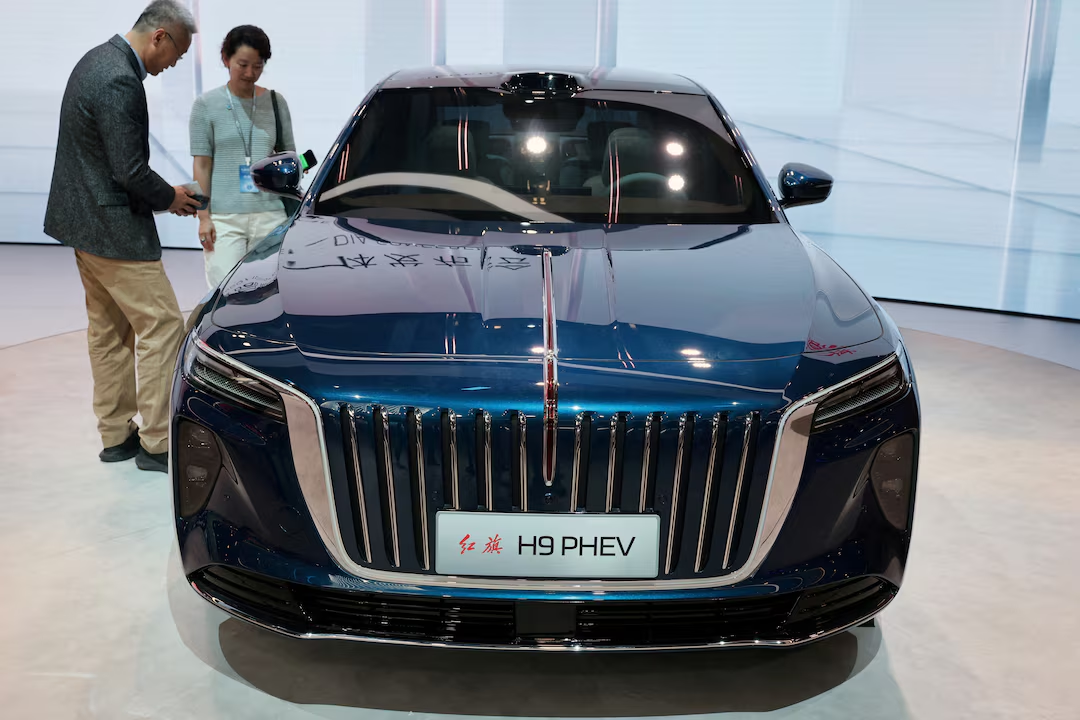
The Hongqi EV comeback is one of the most striking stories in China’s automotive transformation. Once the forgotten state limousine of Mao Zedong’s era, Hongqi—meaning “Red Flag”—has roared back to life with modern electric vehicles, bold design, and soaring sales.
Back in the 1950s, Mao wanted China to have its own national car, free from reliance on Soviet imports. Thus, Hongqi was born under state-owned FAW Group and became the exclusive ride for top officials. Yet, as foreign brands like Audi entered China in the 1980s and 1990s, Hongqi faded. Its gas-guzzling sedans grew outdated, and by the 2000s, production sometimes halted entirely. Even a push into affordable mass-market models after 2013 failed to revive it.
Everything changed seven years ago. FAW—often called the “eldest son” of China’s auto industry—launched a full-scale revival. Critically, it hired Giles Taylor, former design chief at Rolls-Royce, to reinvent Hongqi’s image. Under his leadership, the brand shed its staid look for sharp, modern lines with a distinct “national pride” aesthetic. At the same time, FAW expanded the lineup to include SUVs and, most importantly, electric vehicles.
Thanks to President Xi Jinping’s emphasis on technological self-reliance and cultural confidence, Hongqi regained its status as the preferred car for government use. But more surprisingly, it also attracted young buyers. According to Qin, a 25-year-old university student in Hunan and head of a Hongqi fan club, most enthusiasts are aged 25 to 30—and half are women. “The impressive exterior design is the primary reason most people buy a Hongqi,” he said.
This shift fueled explosive growth. In 2017, Hongqi sold fewer than 5,000 vehicles. By 2024, that number soared to 412,000—a 17.4% year-on-year increase, far outpacing China’s industry average of 5.8%. Now, the brand targets 500,000 sales in 2025, with half expected to come from EVs and plug-in hybrids. Long-term, Taylor aims for 1 million annual sales, though no timeline has been set.
To sustain growth, Hongqi is going global. Facing a brutal price war at home, FAW plans for 25% of Hongqi’s sales to come from overseas by 2030. In November 2024, it shipped its first 600 electric sedans and SUVs to Europe. By 2028, it intends to offer 15 EV and PHEV models across 25 European markets.
Taylor admits competition will be tough in Germany, where loyalty to Mercedes and BMW runs deep. However, he believes Hongqi can win on premium value: packing cars with cutting-edge tech that European brands either lack or deem too costly. Examples include the AI-powered Tiangong EV cockpit, which features voice control, personalized seat and climate memory, and even mood-based music recommendations.
Beyond Europe, Hongqi entered the Americas in 2025 with three models in Mexico. It also launched its ultra-luxury Golden Sunflower sub-brand in Kuwait and other Middle Eastern markets—featuring a 10 million yuan ($1.4M) limousine inspired by ancient Chinese calligraphy.
At the 2025 Shanghai Auto Show, Hongqi doubled down on innovation with a flying concept car and a “science-project” luxury vehicle using fully biodegradable interiors—including seaweed-based carpets and mushroom-derived seat covers.
Still, experts warn challenges remain overseas. “Outside China, Hongqi loses that natural home-field advantage,” said Tu Le of Sino Auto Insights. “They’ve got to figure out how to sell themselves to people who have no idea what Hongqi stands for.”
Meanwhile, rival Audi’s China sales fell 10.9% in 2024, dropping to under 650,000 units. In response, it launched a China-only EV brand—simply called AUDI—without its iconic four rings. But early sales of the E5 Sportback have been modest, underscoring how quickly Chinese brands like Hongqi have seized the momentum.
In essence, the Hongqi EV comeback reflects a broader shift: Chinese automakers now lead in EV speed, tech integration, and design daring. Once a symbol of state power, Hongqi has become a beacon of national innovation—and a serious global contender.
READ: Mercedes-Benz Launches SAE-Level 4 Robotaxi in Abu Dhabi 2026