Affordable EVs with Solid-State Batteries are no longer a futuristic promise. China has turned that vision into reality with the launch of the MG4 compact electric hatchback. Costing between $11,000 and $16,500, the MG4 is the first small mass-market EV to feature semi–solid-state battery technology. This innovation marks a breakthrough in electric vehicle accessibility and safety.
Solid-state batteries offer superior energy density, faster charging, longer lifespan, and enhanced safety. Automakers have long viewed them as the ultimate upgrade from lithium-ion batteries. However, cost has remained a barrier. Now, MG is showing the world that solid-state technology doesn’t have to come with a luxury price tag.
The MG4 uses a semi–solid-state battery from QingTao Energy. This battery contains just 5% liquid electrolyte, using a gel-like substance to create a hybrid system. While its energy density measures 180 Wh/kg—lower than Tesla’s 4680 cells—this design focuses on affordability, cold-weather reliability, and everyday safety.
Traditional EV batteries use liquid electrolytes to move ions between electrodes. In contrast, solid-state designs swap the liquid for a more stable material. The MG4’s semi-solid setup combines benefits from both systems, making it easier and cheaper to produce. Its battery delivers a 537-kilometer range under China’s test cycle, which translates to about 217 miles in U.S. EPA terms.
This battery holds up well in low temperatures, maintaining range and performance even at -7°C (19°F). MG subjected the pack to extreme safety tests, including puncture resistance. Drivers can expect consistent operation in diverse climates—something budget EVs haven’t always guaranteed. The 70 kWh capacity also helps boost the MG4’s range above models like the BYD Seagull.
Affordable EVs with Solid-State Batteries are poised to transform the entry-level EV market. High-end automakers like Mercedes-Benz and BMW already test solid-state systems in luxury prototypes. But MG brings the tech to ordinary buyers. It doesn’t prioritize performance; it offers practicality and innovation at a fraction of the cost.
Despite the MG4’s global appeal, MG currently has no plans to bring it to the United States. That decision leaves American buyers without an affordable solid-state option. In contrast, U.S.-based EV projects like Dodge’s Charger Daytona or BMW’s i7 focus on speed and performance rather than price. U.S. solid-state development lags in affordability and mass deployment.
Even so, MG’s announcement could inspire a change. American consumers are eager for compact EVs with long range and low pricing. MG has proved that automakers can deliver both—if they rethink their approach. Affordable EVs with Solid-State Batteries could enter the U.S. market sooner than expected if rivals follow MG’s lead.
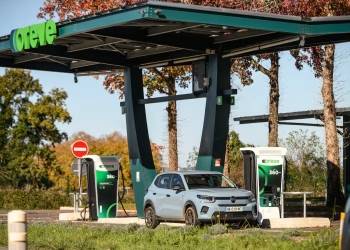
The MG4 stands as a compelling package. It matches its peers in design and utility while offering next-generation tech. With 70 kWh of usable power and efficient range, it handles daily commutes and long trips with ease. China’s robust charging network only strengthens its case as a practical solution.
MG, a British brand now under China’s SAIC Motor, shows that innovation doesn’t need to be expensive. The MG4 proves that budget-friendly EVs can be smart, stylish, and reliable. While it won’t win range contests against top-tier lithium-ion rivals, it achieves what really matters—delivering solid value with modern battery safety.
As other automakers concentrate on high-end launches, China races ahead in democratizing EV technology. With MG leading the charge, the world now sees that Affordable EVs with Solid-State Batteries are no longer a theory. They’re rolling off assembly lines—and into the hands of everyday drivers.