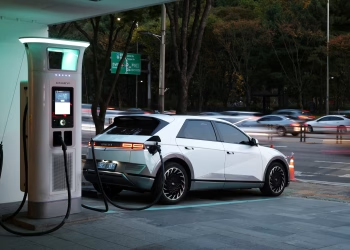
Tesla Japan success stands out as a rare bright spot for the automaker at a time when its global deliveries have fallen across major markets. While sales declined in the United States and China, Tesla nearly doubled its vehicle deliveries in Japan, proving that a disciplined retail strategy can still unlock growth even in difficult conditions. The company’s record year in Japan highlights lessons that struggling EV makers may find increasingly hard to ignore.
Japan remains a relatively small electric vehicle market. Out of roughly 3.8 million vehicles sold last year, only about 60,000 were battery powered. Despite this, Tesla delivered approximately 10,600 vehicles, almost twice its previous year’s total. This performance did not rely on new models or aggressive discounts. Instead, it focused on how cars are sold and explained to customers.
Tesla Japan success driven by retail fundamentals
At the core of Tesla Japan success was a shift away from an online-only sales mindset. The company leaned more heavily into physical retail experiences that mirror traditional dealerships, while still maintaining direct-to-consumer pricing. According to Japanese business reporting, this change helped bridge a gap between Tesla and consumers unfamiliar with EVs.
Tesla expanded its network of permanent showrooms, placing them inside high-traffic shopping malls. These locations allowed curious shoppers to encounter Tesla vehicles organically, rather than seeking them out online. Test drives were offered in adjacent parking areas, lowering barriers for first-time EV buyers.
Leadership changes behind Tesla Japan success
A key turning point came in September 2024, when Tesla appointed Richi Hashimoto, formerly of Red Bull, as its country manager in Japan. Under his leadership, Tesla accelerated showroom expansion and rethought its approach to customer engagement.
Hashimoto emphasized visibility and education. He noted that with low brand awareness, few people would intentionally visit a Tesla location. Therefore, the strategy focused on introducing the brand to consumers before expecting sales conversions. This approach aligned well with Japan’s cautious consumer culture.
Training and education reshape EV sales
Another pillar of Tesla Japan success involved intensive staff training. Japan lags behind other markets in EV adoption, which means many buyers are unfamiliar with electric vehicle concepts. For sales teams, explaining charging, battery range, and ownership costs often requires starting from scratch.
When Hashimoto arrived, only a small share of Tesla’s sales staff met internal standards for EV knowledge. Tesla invested heavily in education, ensuring employees could confidently guide customers through the transition from gasoline vehicles. As a result, showroom interactions became more informative and less intimidating for first-time buyers.
Read Also
Lucid CEO outlines future EV strategy
Zeekr 7GT signals new EV competition
Elon Musk’s Grok AI and automation vision
Lessons for EV makers struggling elsewhere
The implications of Tesla Japan success extend beyond one country. In the United States, many traditional dealerships remain hesitant to promote EVs. Electric vehicles disrupt familiar profit models by reducing maintenance revenue and requiring additional staff training. Consequently, sales efforts often lack enthusiasm.
Yet EVs offer clear benefits to consumers, including lower operating costs, quieter operation, and advanced software features. Automakers launching new models would benefit from prioritizing education and exposure rather than relying solely on online ordering systems.
Market context matters for Tesla Japan success
It is important to note that Tesla’s global sales challenges stem from multiple factors. The company faces an aging lineup, a strategic pivot toward AI and robotics, and, in some regions, political backlash tied to its CEO. Competition has also intensified in mature EV markets, where buyers have more choices than ever.
Japan presents a different environment. EV options remain limited, and Tesla still carries a novelty factor. This helped amplify the impact of its retail strategy. However, novelty alone would not sustain growth without effective execution on the ground.
Global contrasts highlight strategic gaps
Elsewhere, Tesla posted gains in select markets such as Norway and Turkey. In Norway, nearly one in five EVs sold last year carried the Tesla badge. In Turkey, Model Y sales added meaningful volume. Still, these successes contrast sharply with declines in larger markets, underscoring how local strategy influences outcomes.
For automakers preparing to launch dozens of new EVs in the coming years, the message is clear. Retail presence, knowledgeable staff, and consumer education remain critical. Technology alone does not sell cars.