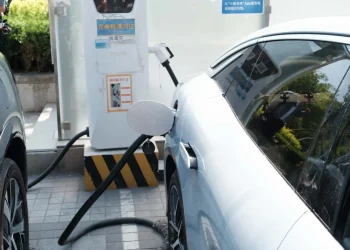
DC fast charging stations in the U.S. are growing in size and capacity, offering a major improvement for electric vehicle drivers. According to new data from research firm Paren, the average number of charging ports at newly built stations between January and May 2025 has increased to 4.7 per site. Previously, most fast-charging stations had just one or two ports, which often led to long waits and limited compatibility.
For seasoned EV drivers, this change is welcome. Many have experienced the frustration of arriving at a station only to find one functioning port—or worse, one that doesn’t support their vehicle’s plug type. As a result, early charging experiences often lacked convenience. Fortunately, things are changing for the better.
Paren’s latest report clearly marks a transition from the early Charging 1.0 era, where minimal installations slowed down growth. Today, most operators understand that more ports mean more satisfied customers. Importantly, the industry has begun learning from past missteps and is now moving toward better solutions.
Significantly, newer market entrants are leading the charge. Companies such as Revel, Mercedes-Benz High-Power Charging, Walmart, and Ionna are all adopting a “bigger is better” strategy. Their stations consistently offer multiple high-speed ports to meet increasing demand. At the same time, Tesla, long a benchmark in EV infrastructure, continues to expand its network of multi-stall Superchargers across the country.
Meanwhile, other companies are starting to follow suit. For instance, ChargePoint—once averaging just 1.5 ports per station—has now raised its average to 2.3 ports. In some cases, the number climbs even higher. This shift demonstrates a strong commitment to scaling infrastructure and meeting user expectations.
Moreover, Paren’s findings reveal that 82% of new DC fast charging stations in 2025 include three or more ports. This growth trend points toward a future where larger and more powerful stations dominate. Consequently, drivers will benefit from better access, reduced wait times, and fewer hardware mismatches.
Beyond convenience, this trend represents a broader shift in how the U.S. is building its charging infrastructure. As electric vehicle adoption accelerates, both private and public sectors are investing more in scalable, future-ready charging networks. With expanded port capacity, stations are now more capable of serving both local users and long-distance travelers.
Additionally, larger installations are more cost-effective in the long run. They reduce per-port installation costs, improve reliability, and ensure a better return on investment. As more charging stations incorporate higher port counts, consumers can expect a smoother and more consistent charging experience across regions.
In conclusion, the rise in average port numbers at DC fast charging stations is not just a technical detail—it’s a key milestone in EV adoption. Drivers can now rely on faster, more flexible charging, while operators improve service and efficiency. This momentum is essential for creating a robust and driver-friendly electric ecosystem.
READ: Ultra-Fast Charging EV Launch: BYD Han L Sedan Charges 400 km in 5 Minutes